Analysis of sustainable urban mobility in Porto
Service Design Thinking
ECO-SD methodology
Stakeholders & Customer Journey Mapping
Semi-structured Interviews
Expertise/Skills
Problem
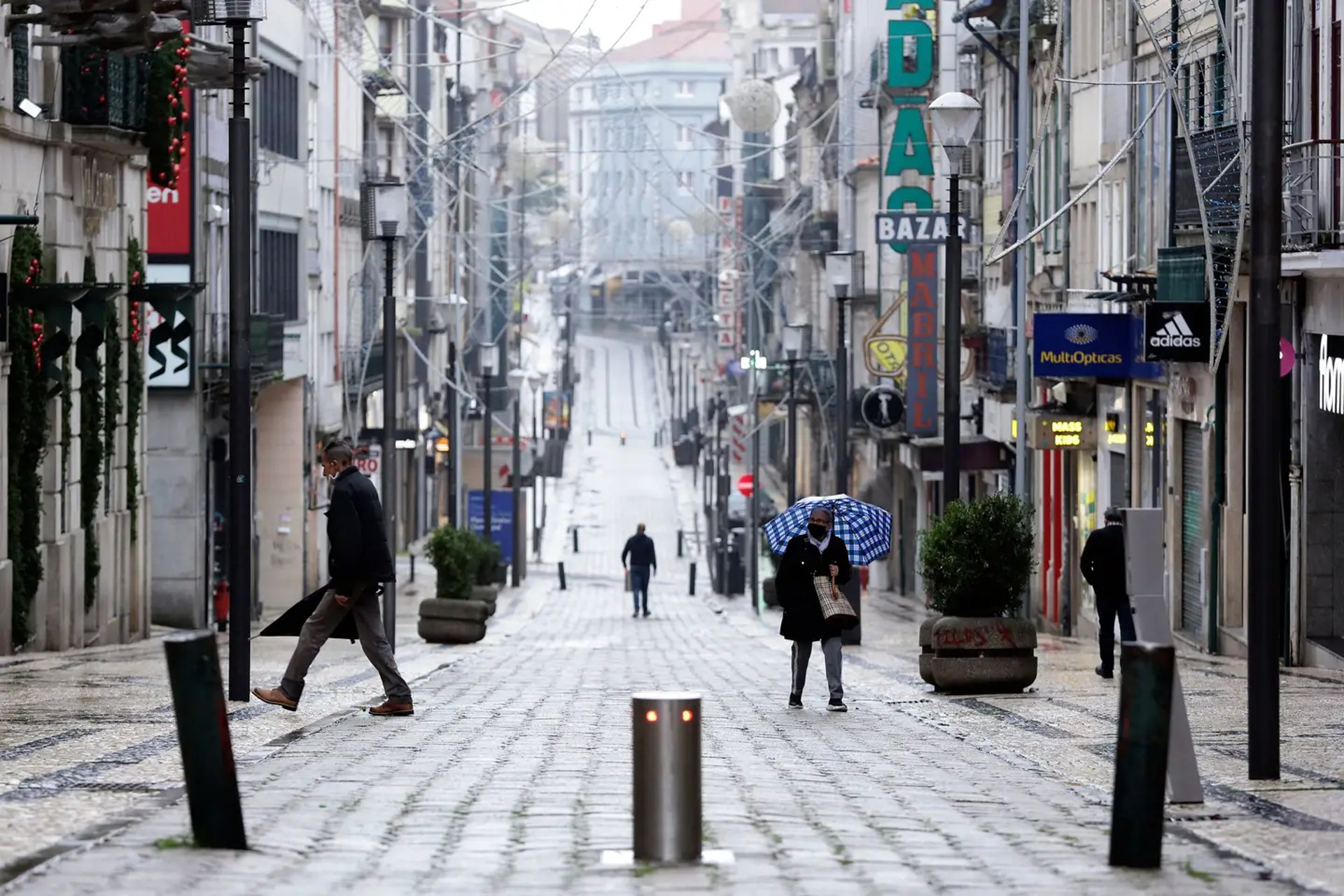
The mobility sector in Porto faced a sustainability and resilience crisis, exacerbated by COVID-19. The pandemic led to a sharp decline in public transport usage and a return to private vehicles, increasing carbon emissions and exposing the fragmentation of digital services, which lacked fare integration, real-time data, and interoperability between public and private operators.
Despite the pandemic having passed and advances in sustainable mobility, this study still addressed ongoing challenges and therefore proposed solutions based on the research findings.
Solution
Solutions were proposed using a service design methodology that systematically linked user pain points with environmental performance.
The main deliverable was a set of practical guidelines to support business models in hybrid mobility, focusing on interoperability, digitalization, and collaboration among stakeholders to improve user experience and reduce environmental impact.
Joint Research
CEiiA
University of Porto
Initial Research
Analysis of Porto’s mobility infrastructure
The project conducted a comprehensive assessment of Porto’s existing mobility infrastructure, including:
Mapping of the city’s rail and road networks (Metro do Porto, CP, and STCP) alongside their current decarbonization levels.
Evaluation of the cycling network, detailing its current 35 km extent and planned expansions.
Identification of micromobility operators (Bolt, Bird, FreeNow) and on-demand services (Uber, Bolt).
Benchmarking Global Trends
An investigation into Smart City initiatives worldwide was carried out to uncover best practices and innovative solutions applicable to Porto. This included:
Real-time traffic information systems and emergency vehicle monitoring.
Mobility as a Service (MaaS) implementations in cities such as Helsinki.
Private vehicle restriction strategies adopted by cities like Barcelona and Stockholm.
Objectives
Understand what changes occurred in mobility patterns in Porto during the COVID-19 pandemic
Understand the main emerging trends in urban mobility.
Use service design methods to identify opportunities for hybrid and sustainable mobility services.
Data Collection & Analysis
Sampling and participants
To ensure a comprehensive understanding of the mobility ecosystem, the study involved a diverse sample of 22 participants selected for their theoretical and practical relevance.
Data collection and analysis
The primary data collection method was semi-structured interviews, each lasting between 30 to 60 minutes. This approach allowed flexibility to explore in depth participants’ real experiences and future perspectives through open-ended questions.
The interview guide focused on key areas including changes in mobility behavior due to the pandemic, the role of technology in new business models, barriers to public and micromobility transport, and collaborative strategies to achieve carbon neutrality.
Thematic analysis and coding
Interview data were analyzed using Thematic Analysis, following a six-stage process: familiarization, initial code generation, theme searching, reviewing, defining/naming themes, and report production. This resulted in 261 primary codes, grouped into 11 subthemes, which were further synthesized into three overarching themes: Urban Mobility and Planning, Experience Requirements for Public and Alternative Modes, and Carbon Neutrality.
Stakeholders & Journey Mapping
The discovery phase also involved visually mapping citizen interactions through Customer Journeys, comparing the periods before and during the pandemic.
ECO-SD Methodology: The journey structure was based on the ECO-SD method, which aims to identify user experience barriers alongside environmental performance barriers.
Barrier Classification: The research identified and categorized obstacles across multiple levels: Technological (lack of real-time data), Service (lack of price transparency), Physical (inadequate urban infrastructure), etc.
Stakeholder Mapping: Stakeholders were prioritized into three levels of interaction (Core, Involved, and Monitor) to ensure realistic partnerships and avoid conflicts of interest within the ecosystem.
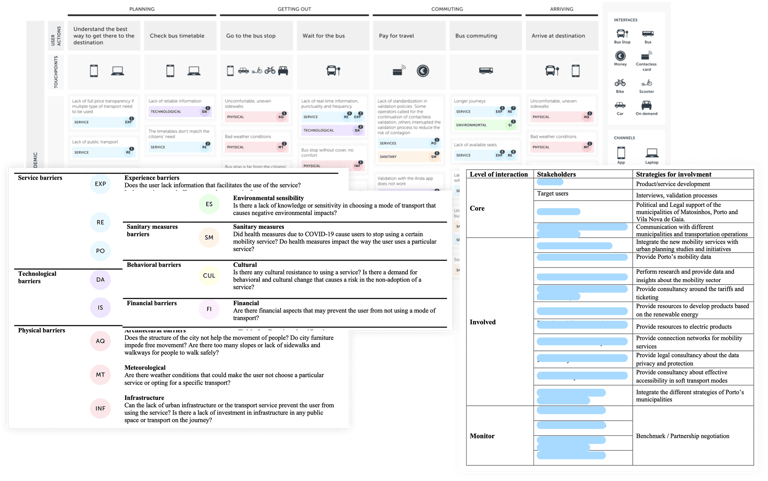
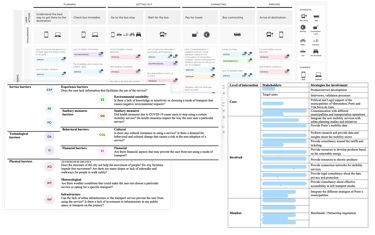
User journeys, service barriers, stakeholders map
Deliverables
Proposed Solutions: Based on identified barriers, challenges an overall research findings, practical improvements were suggested across transport modes to enhance efficiency and user trust.
Managerial Implications: Guidelines were provided to help management develop resilient
and adaptable services. Key points include:
Leveraging new technologies (AI, IoT, Big Data, Blockchain) for interoperable, personalized mobility experiences;
Aligning urban planning beyond car-centric models and fostering citizen participation;
Promoting shared responsibility for carbon neutrality through incentives and transparent emissions data;
Adopting a customer- and ecosystem-centric approach with ongoing service design practices to ensure adaptability in hybrid mobility contexts.
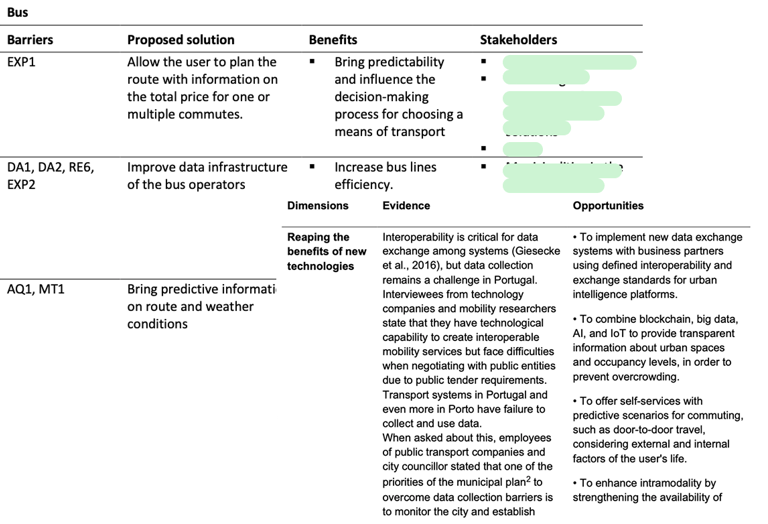
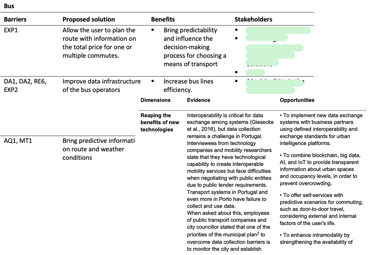
Proposed solutions and managerial implications divided by different thematic dimensions.
Leanings
Methodological Approach and Data Collection
Looking back, adopting a human-centered and qualitative exploratory approach proved essential to capture the complexity of Porto’s mobility ecosystem under pressure. The thematic analysis process allowed the emergence of nuanced themes around urban mobility, user experience, and carbon neutrality, shaping a solid foundation for further inquiry.
Design Tools as Analytical Instruments
Throughout the project, service design tools were not merely descriptive but instrumental in uncovering hidden opportunities. Mapping customer journeys with the ECO-SD methodology helped visualize the intersection of user experience and environmental impact, revealing concrete barriers
Supporting CEiiA Through Strategic Partnerships
A key part of the research involved identifying and fostering strategic partnerships to support CEiiA’s role within the mobility ecosystem. By mapping stakeholders and their levels of engagement, the project provided actionable insights on how to coordinate efforts between municipalities, technology providers, and academic institutions.
Publication
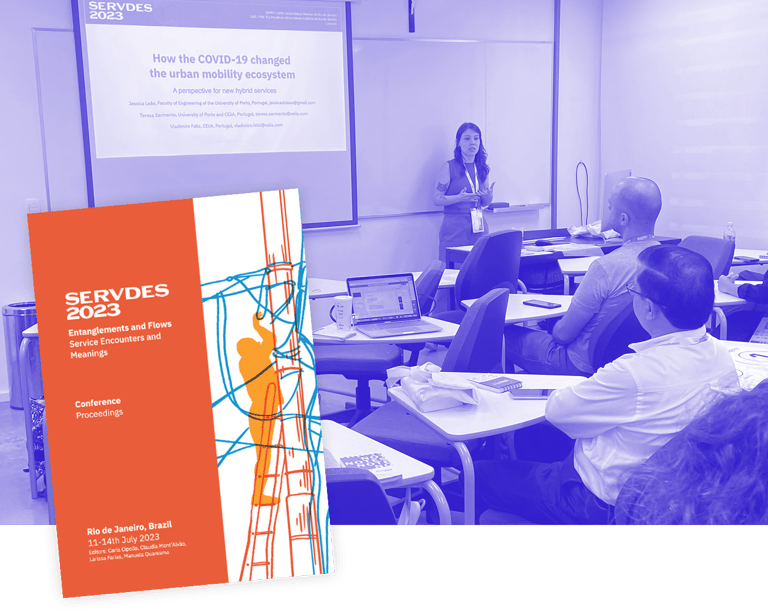
This work was presented at the ServDes Conference in 2023, which was a great pleasure. You can check the paper here