Embedding Research into the Design Process at EasyWP
ResearchOps
Stakeholder Alignment
Workshop Facilitation
Semi-structured Interviews
Challenge
The EasyWP design team was already mature and involved in planning and prioritization, with a strong design-driven mindset. However, design decisions were largely based on assumptions due to the lack of user data, research infrastructure, and documented customer understanding. There were no personas or user journeys to align teams around a shared customer vision.
Context
Improve design decision-making by grounding it in real user data, while creating a scalable research and evaluation process for a small design team.
Expertise/Skills
Design process — before
The process was working reasonably well, but we felt a lack of data to support our design decisions and to improve performance across each phase of the process.
Discovery: Learn, ideate, test, and create concepts.
Design: Once requirements are defined and we know what we want to build, we move into the design phase.
Implementation: Ensure that everything is built according to the design.
Phase 1 — Research foundations and measurement
To reduce assumptions and improve decision-making, we focused on building a strong research and evaluation foundation:
Created a central research repository with templates for qualitative and quantitative studies, competitor analysis, customer support insights, and project documentation.
Introduced usability testing to validate flows early, leveraging internal colleagues as proxy users when direct access was limited.
Implemented Amplitude to collect quantitative data and defined tracking endpoints for every design project.
Launched in-product feedback to capture contextual qualitative and quantitative insights.
Designed and ran bi-annual surveys to understand customer profiles, product understanding, and the overall website creation experience.
Shared interactive research reports across teams, which became a recurring input for planning and prioritization.
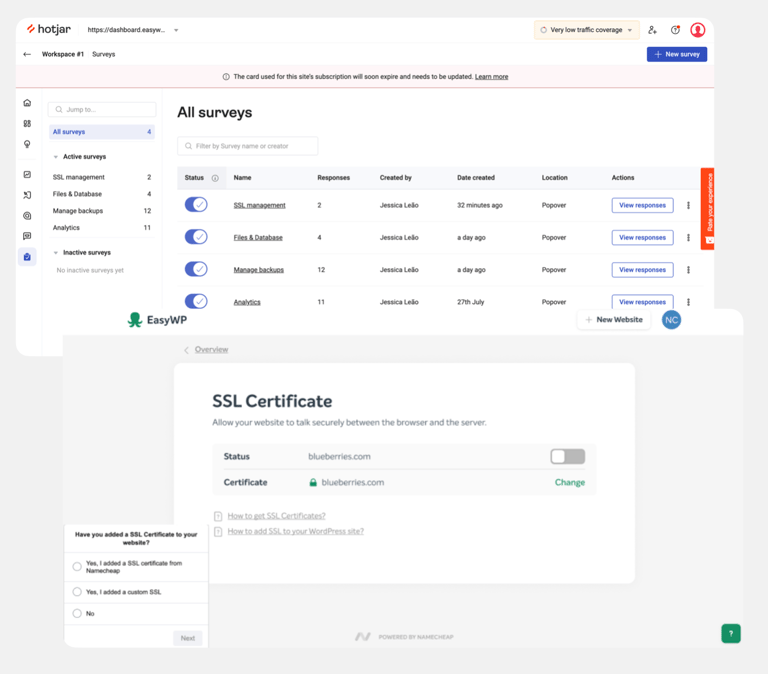
In-place customer feedback by feature
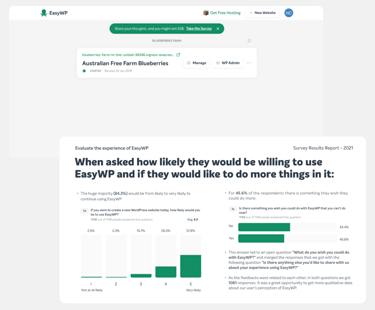
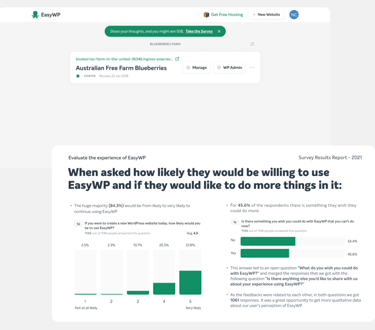
Bi-annual surveys
Phase 2 — Personas and product insights
With stronger data in place, we moved into deeper user understanding and product discovery:
Conducted semi-structured interviews with beginner, intermediate, and advanced users in website creation/management.
Synthesized interview findings and survey data into validated personas.
Identified recurring patterns, motivations, and pain points through collaborative analysis workshops.
Created an Opportunity Tree (inspired by Continuous Product Discovery book), connecting business outcomes with user needs, opportunities, and solution hypotheses
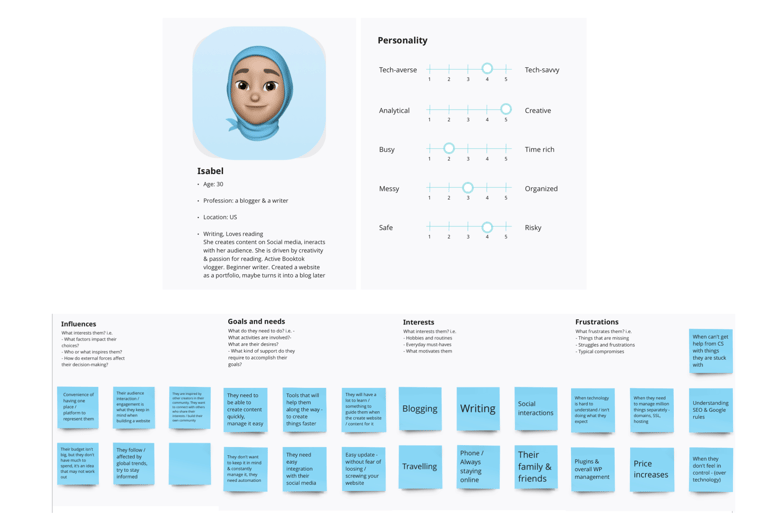
Screenshot from a co-created persona workshop, used to share insights and involve external teams in building personas.
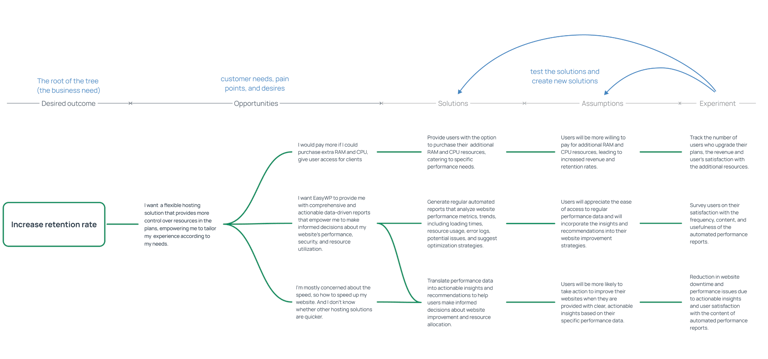
Opportunity solution tree logic
Results
The tools introduced in Phase 1 are still part of the daily workflow for EasyWP designers. They have significantly improved confidence in decision-making, increased agility, and reduced uncertainty by grounding solutions in real data.
Several initiatives derived from the Opportunity Tree are currently being implemented, demonstrating increased trust in the design team from stakeholders. For example, Resource customization, which allows users to purchase resources separately based on their needs, resulted in 890 extra sales in the first month, without any marketing involvement.